

- 45min
- free
- 5-10
- English
Description
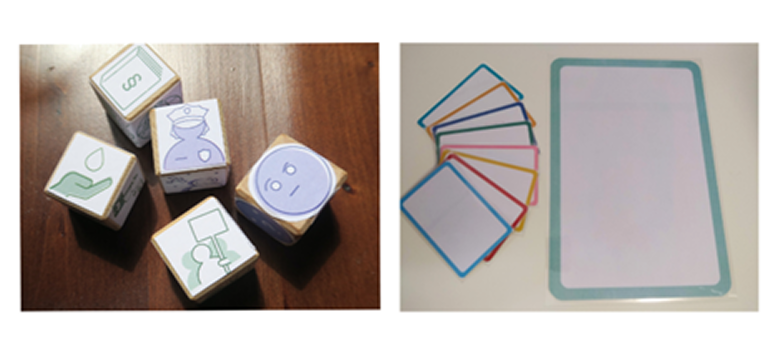
Fake Expert is a communicative game of social deduction using Demodice cubes. Players take the role of talk show guests making short statements about democratic issues and trying to expose one fake expert player. The game is split into four phases. First, a host is selected among the players. He/she decides a main topic by throwing Demodice, picking a die, and writing the topic on the main topic card. Then the host decides on a subtopic of the talk show and writes it to all subtopic cards except one. The host shows the main topic card to all participants and distributes the subtopic cards. A player with a subtopic card will be a guest, and a player with an x will be the fake expert. Second, the host announces talks show to begin, and each guest and the secret fake expert will make a short comment about the topic on their turn for a few rounds. The fake expert tries to sound convincing without knowing the subtopic. Third, the host announces accusations to begin. Players have three minutes to discuss who the fake expert is. In the fourth and final phase, after time runs out each guest and the fake expert points out who they think is the fake expert. If guests manage to point out the fake expert by majority they win, unless the fake expert succeeds to guess the subtopic, then Fake Expert and host win. Otherwise, the fake expert and the host will win.
Fake Expert is a fun game and could be used as a method to introduce democracy or human rights to participants. Also, the developers put great emphasis on a debriefing session after playing to discuss themes of the game with the participants. The rules are hard to grasp at first, but when participants have played for a while, games are quick and enjoyable.
Watch How It Works
Method & Activity Information.
- Difficulty: Medium
- Session location: Physical
- Test date: 06/02/2026
- Duration: 45min
- Costs: free
- Materials used: Printed rules sheet, laminated game cards and board, and Demodice cubes
- Youth participated: 5
- Registration: none
Case Description
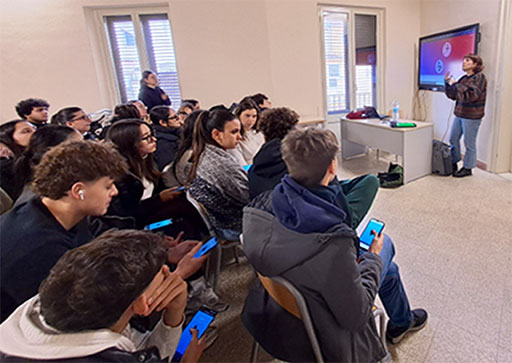
Since we had reserved almost 2 hours, we combined two methods testing Demodice and Fake Expert into the same workshop. Besides, both methods are from the same Democracy game box by Demogames. We started with Demodice, had feedback session from the game, took a break, and continued with Fake Expert. In this workshop we wanted to play more Fake Expert, so we played Demodice shorter time. In this method test description, we will only introduce Fake Expert. Demodice test description is in a separate test description document.
We tested Fake Expert, because it seemed like a promising method to engage youth to have fun and get them to think about societal issues and misinformation. Besides, we could not find any real-life examples where an organization or people have used this method, so we wanted to test the method’s usability. For example, how much participants enjoyed playing the game and in what contexts Fake Expert could be applied to support youth societal participation. We got 5 university students to participate in our game session to play Fake Expert. We provided students with snacks and drinks, and they would also receive points for a university course by writing a report on the game session.
Method Usage
We facilitated the game session in Finland at Tampere university’s meeting room with a long table where participants could face each other. The room also had a screen where we showed our presentation slides to introduce the game session and Fake Expert.
Method & Activity Feedback
Fake Expert Game Session with University Students
Facilitator
Category
Likert-7 AVG
Description
Effectiveness
5.2
-
Efficiency
5.7
-
Learnability
5.3
-
Enjoyability
6.7
-
Adaptability
6
-
Feedback (recommendation)
5.5
Observer
Category
Likert-7 AVG
Description
Engagement & Participation
6
-
Comprehension & Knowledge
5.7
-
Game Mechanics & Functionality
6
-
Participant Experience
Category
Likert-7 AVG
Description
Enjoyment
6.2
Participants enjoyed most participation with others, guessing and discussing who the fake expert. Participant found challenging finding the Fake Expert and as a Fake Expert guessing the subtopic.
Usability
5.7
-
Learnability
5
-
Recommendation score
5.7
-
Positive
Most participants liked Fake Expert more than Demodice, since it felt more like a game.
“It was not boring, you had to keep focus.”
“For host it was interesting how the fake expert is going to defend himself.”
“Fun to see fake expert to say obvious things and not getting caught”
Negative
There was somewhat longer pauses when players thought about their comments. “This is hard”.
Suggestions & tips
It is good to tell participants when you get the cards, you should look at them for a same amount of time, so you do not reveal your role.
Emotion dice has a bit similar topic, so we left it out on our second round. You can consider this when you host a session.
“Could be easier in class if you had discussed these topics first and then play the game”
– Where this method could be used to enhance youth participation?
o Learning new topics, everyone would need to learn new topics.
o I think after rounds when topic has been played around, there could be actual presentation what the actual thing is.
“Some more time for thinking before round 2. But it would help the fake expert too”
Koliko vam je koristan bio ovaj članak
Kliknite na zvjezdicu da ocijenite!
Prosječna ocjena 0 / 5. Broj glasova: 0
Još nema glasova! Budite prvi koji će ocijeniti ovaj članak.
Žao nam je što vam ovaj članak nije bio koristan!
Dozvolite nam da poboljšamo ovaj članak!
Recite nam kako možemo poboljšati ovaj članak
Related methods
90min
10+
English
Odluka je na vama! je obrazovna, višestranačka društvena simulacija dizajnirana za mlade starije od 14 godina. [...]
45min
5-10
English
Fake Expert is a communicative game of social deduction using Demodice cubes. Players take the role [...]
4h
unlimited
English, Bosnian, Estonian, Finnish, Italian
“To Vote or Not to Vote?” is a discussion-based simulation where participants are assigned either roles [...]