

- 120min
- free
- 10+
- English, Finnish
Description
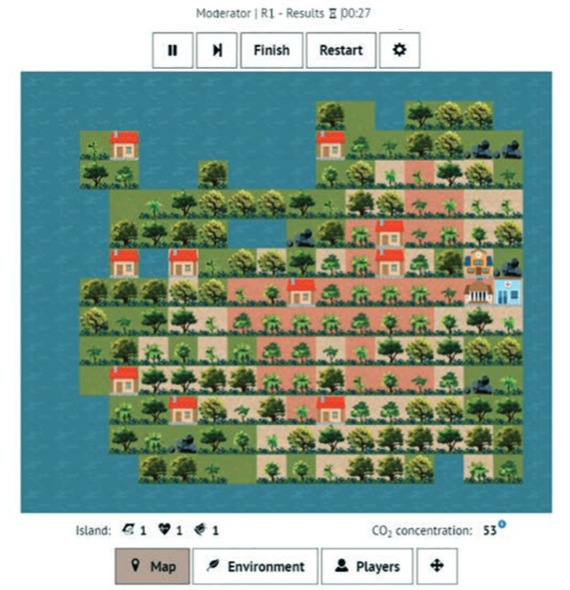
In New Shores players are sent to an island rich in resources where they engage in a variety of activities, and either learn to collaborate for the common good or choose to pursue their individual goals. The game board consists of different tiles like a tree, a house, and coal. By interacting with them, players can cut down trees, extract coal, build private housing or public infrastructure. However, some actions affect the climate causing natural disasters on the island destroying player-built infrastructure and nature. Players can still try to change the situation by planting trees. Through collaboration, players can complete larger building projects increasing the island’s status and transfer each other currency or just build luxury for themselves and become the richest. To use the game for learning purposes, facilitator can encourage discussion among participants.
Watch How It Works
Method & Activity Information.
- Difficulty: Medium
- Session location: Tampere University, Finland
- Test date: 09/06/2025
- Duration: 120min
- Costs: free
- Materials used: Participants used laptops to play the game
- Youth participated:
- Registration: required

Case Description
New Shore’s developers say New Shores to impact climate awareness and collaboration from middle schoolers to university students, but we were also curious how useful it is in youth societal participation context. So, we hosted a gaming session with university students at Tampere University. Initially, we aimed to recruit the recommended 7-10 participants, but only 2 participants joined. So, one of the GameIN researchers joined the game to have at least 3 players. We offered snacks and drinks to the participants.
Method Usage
Before the session we had asked participants to read the game manual at home, but before playing we briefly explained the mechanics to them. After that, we played a practice round, so participants could try the game once. Before playing for real, we told them there’s no clear goal in the game, so they’re allowed to form their own goals to pursue. At the beginning rounds the participants mostly did whatever they wanted. Extracted coal, built houses, and cut down trees. Each round ends with a result view where the host pointed out the island’s CO2 emissions, education level, food etc. When playing continued, some buildings were destroyed by disasters. One player became homeless after their home was swept by a hurricane. At the sixth round the host asked the players to hold a council meeting to discuss how to proceed with continuing rounds. Main topics were to decrease CO2 emissions by planting trees and raising island’s low education level by collaborating to build a university. After this, players collaborated more and were able to plant more trees and build a university.
After the game part, we held a debriefing session to discuss themes of the game, overall usability and use in youth societal participation context. Read the results of the discussion in the participant experience section.
Method & Activity Feedback
Facilitator
Category
Likert-7 AVG
Description
Effectiveness
6.7
Efficiency
6.7
Learnability
6
Enjoyability
6
Adaptability
5.3
Feedback (recommendation)
5
Observer
Category
Likert-7 AVG
Description
Engagement & Participation
6
Comprehension & Knowledge
5.9
Game Mechanics & Functionality
6
Participant Experience
Category
Likert-7 AVG
Description
Enjoyment
6.1
Usability
6
Learnability
4.4
Recommendation score
5.3
Quite interesting, more people would have been interesting to have!
Positive
“Not really discussion between the players during the “planning phase” at the middle of the game, needs encouragement. Administrators do all the talking. More discussions later at the end of the game from participants when asking feedback.”
“It would be interesting to see how council meeting would go with school children who do not know about sustainability?”
“If the target is school children this can make them to be more serious than they usually are. But the competitive aspect like a score system that can make bias to the message of the came.”
“When we play this game there is no consequences.”
Negative
“When we play this game there is no consequences.”
Suggestions & tips
Participant: “There should be a ranking feature how good an island did you get”. Note: There is a player tab where ranking can be seen, but we didn’t show it to participants, because it reveals every player’s resources to other players. However, it may be good to raise competition among players.
“There could be role cards for evil and good goals as a game mechanic.”
“It would be interesting to see how the council meeting would go with school children who do not know about sustainability.”
“If the target is school children, this can make them to be more serious than they usually are. However, a competitive aspect like a score system can make bias to the message of the game.“
How useful was this post
Click on a star to rate it!
Average rating 5 / 5. Vote count: 1
No votes so far! Be the first to rate this post.
We are sorry that this post was not useful for you!
Let us improve this post!
Tell us how we can improve this post
Related methods
60min
2-6
In the Chancellor Simulator, players experience the beginning and course of a legislative period as chancellor [...]

60min
20+
English
The Boiling Frog Game is an online role-play simulation that aims to raise awareness about how [...]
90min
10+
English
Up to You! is an educational, multi‑stakeholder social simulation designed for youth over 14 years old. [...]
4h
unlimited
English
Photovoice is a qualititative research method where photographs and narratives are gathered by community members to guide [...]