

- 60min
- subscription
- 20+
- English, Estonian
Description
A pedagogical escape game involves participants collaboratively solving puzzles and completing tasks within a set timeframe to achieve specific educational objectives. It combines teamwork, problem-solving skills, and active learning, making abstract concepts engaging and tangible. Typically conducted in a physically interactive environment, it is adaptable for various educational topics, including democracy, citizenship, human rights, or environmental education.
Method & Activity Information.
- Difficulty: Medium
- Session location: Tallinn University, Estonia
- Test date: 25/02/2025
- Duration: 60min
- Costs: subscription
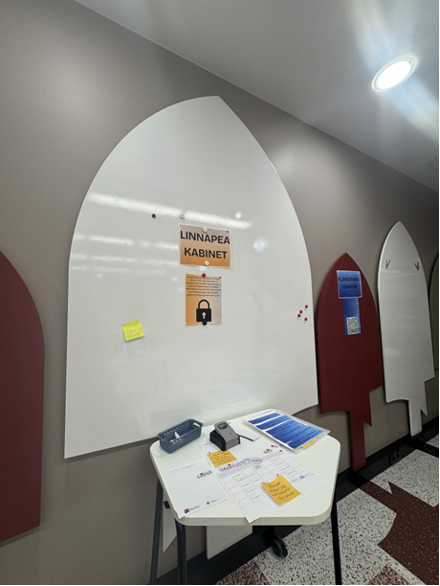
- Materials used: Puzzle locks, thematic clues (printed materials), hidden objects, timer, room decoration
- Youth participated: 20
- Registration: none
Case Description
Participants in this activity explored themes related to youth democracy and active citizenship. The escape room aimed to deepen understanding of democratic processes, decision-making, and youth participation through engaging, hands-on experiences. In our case, in Estonia, the topic was „Youth take over the municpality“ and the participants needed to find a way to ensure youth voices in the town remain heard. We used this method on University students learning Youth work in Tallinn University (Bachelor’s degree students, years 1-3).
Stakeholders
- Youth participants
- Youth workers and facilitators
- Educational institution
Needs & requirements
- Enhanced understanding of democratic participation
- Increased youth engagement and motivation
- Interactive learning experience
Problems
- Low youth participation in democratic processes
- Lack of understanding about democratic rights and duties
Topic & themes
The escape room addressed youth democracy, active citizenship, teamwork, and collaboration through a series of democracy-themed puzzles and challenges designed to highlight participation processes and decision-making.
Method Usage
Context: Educational (we used it in Tallinn University)
Country & City: Tallinn, Estonia
Target group: For us, youth from age 18, studying in University.
Purpose & reason to choose this method
Chosen to engage young participants actively in learning about democracy, encouraging teamwork, and increasing motivation through an interactive game format.
Participants were grouped into small teams tasked with solving a series of democracy-themed puzzles. Each puzzle station required cooperation and democratic decision-making, progressively leading to a deeper understanding of democratic concepts.
Participants successfully collaborated and engaged with democratic concepts, demonstrating increased understanding and enthusiasm towards democratic participation and active citizenship.
Method & Activity Feedback
Facilitator
Category
Likert-7 AVG
Description
Effectiveness
4.5
How well the method supported learning and allowed flexible adjustments to improve outcomes.
Efficiency
6
How smoothly the method functioned in the given setting (online or physical), with minimal issues.
Learnability
5
How easily the method could be understood and tailored to different participant groups.
Enjoyability
7
The facilitator’s and participants’ enjoyment, including engagement through gamified elements.
Adaptability
4
The facilitator’s ability to modify the method to suit participant needs and session dynamics.
Feedback (recommendation)
7
The facilitator’s confidence in recommending the method and their belief in its value for future use.
Observer
Category
Likert-7 AVG
Description
Engagement & Participation
5.1
Observers’ impression of how involved and motivated participants were during the activity.
Comprehension & Knowledge
5
Evidence that participants grasped key concepts and could apply or articulate their learning.
Game Mechanics & Functionality
4.8
How well the method’s rules, tools, and rewards functioned and supported the learning experience.
Participant Experience
Category
Likert-7 AVG
Description
Enjoyment
5.2
How much participants liked the activity and whether they would want to engage with similar methods again.
Usability
4.2
How clearly the activity was presented and how easy it was to complete with confidence.
Learnability
3.5
Whether the activity helped participants learn new things, feel more confident, and stay interested in the topic.
Recommendation score
5.3
Whether participants would recommend this method to others based on their overall experience.
Positive
Facilitators found the method engaging and effective at sustaining participant interest. It provided a practical approach to learning complex concepts like democracy and citizenship.
Negative
The preparation time was extensive, and logistics for the physical setup required careful planning. Some participants needed additional support with the more challenging puzzles.
Suggestions & tips
Prepare thoroughly beforehand, ensuring all materials are ready and clearly explained. Include a facilitator guide with hints for challenging puzzles. An introduction to the topic and a long preparation and testing period are necessary before the method can be built. The classroom environment needs to be well thought out.
Kui kasulik see postitus oli
Hinnangu andmiseks klõpsake tärnil!
Keskmine hinne 0 / 5. Häälte arv: 0
Hääli veel pole! Olge esimene, kes seda postitust hindab.
Kahjuks ei olnud see postitus Teie jaoks kasulik!
Aidake meil seda postitust parandada!
Kuidas saaksime seda postitust parandada
Related methods
45min
10+
Finnish
Maptionnaire is a participatory method for collecting location-specific insights and feedback using interactive, map-based questionnaires. In [...]

4h
unlimited
English, Estonian
Young World-Changers is a civic education program initiated by the Tallinn Education Department, based on the [...]
150min
10+
English, Finnish
The EU Youth Strategy game is a concept created by Lahti city Youth Services DramaLab, a group of young people aged 18-25 [...]